
Flat work · Residential
Stamped concrete for outdoor living.
Patterned concrete for pool decks, driveways, entries, walkways, courtyards, outdoor seating and patios. The look of brick, cut stone or timber, placed as one continuous slab.
The material
Patterned concrete,
poured in one piece.
Stamped concrete is also called patterned or imprinted concrete. It goes down as a normal slab, takes its colour while the surface is still plastic, and then we press it with textured mats before it sets. What you end up with is one continuous surface carrying the pattern of brick, flagstone, cut stone or timber plank.
We can work the material for texture and colour to complement virtually any architectural style, and it does that at a fraction of the cost of traditional pavers and natural stone. One slab. One set of joints. No individual units to bed, level and keep level.
We work in stamped concrete, stained concrete, stone landscaping, polished concrete and paving stone for residential outdoor living areas. Before recommending a pattern we look at the architectural style of the house, its colour scheme, its historical character and the landscape it sits in. A cobblestone that suits a brick Victorian will look wrong against a flat-roofed modern build, and the reverse is just as true.
Applications
Where it goes,
and why it stays.
Pool decks, driveways, entries, walkways, courtyards, outdoor seating areas and patios. Anywhere you would otherwise lay pavers or set stone, a stamped slab will usually do the same job with less to go wrong later.
- Lower maintenance than traditional pavers
- Never needs resetting or replacing
- Reduced labour costs during installation
- Climate-resilient through Colorado's harsh seasons
- Increases property resale value
- Adds instant curb appeal
Stamped, pavers or stone
Three ways to build
the same patio.
All three give you pattern underfoot. But they behave differently once they've been through a few Colorado winters, and they fail differently too.
| Characteristic | Stamped concrete | Pavers | Natural stone |
|---|---|---|---|
| Structure | One continuous slab, jointed by the contractor | Individual manufactured units on a bedding layer | Individual quarried units on a bedding layer |
| Relative cost | The lowest of the three | Higher than stamped concrete | Highest of the three |
| Installation labour | Reduced: the surface is placed and stamped in one operation | Unit by unit, set and levelled by hand | Unit by unit, often with cutting and fitting on site |
| Long-term upkeep | Lower than pavers; never needs resetting or replacing | Units can settle and need lifting and resetting | Units can settle; joints may need re-bedding |
| Joint behaviour | Few joints, cut and controlled by design | Many joints; sand can wash out and weeds can take hold | Many joints; sand or mortar can wash out or crack |
| Pattern and colour range | Texture and colour worked to suit almost any style | Limited to the shapes and colours manufactured | Limited to what the quarry produces |
| Localised repair | Patched or resurfaced; colour matching takes care | Single units can be lifted and swapped out | Single units can be lifted and swapped out |
How we make a stamped slab
Six steps,
and a short window.
Stamping is the one part of flat work you can't reschedule mid-job. Once the concrete is down, the clock belongs to the slab.
Place and screed
Base compacted, forms set to line and fall, concrete placed and struck off to grade. We decide slope here, because water has to leave the surface for the life of the slab.
Float the surface
Bull float, then wait for the bleed water to leave. Working colour or mats into a surface that still has bleed water on it drives water back down and weakens the top few millimetres.
Colour
Either integral colour batched through the whole load, or a dry-shake colour hardener broadcast and floated into the surface. Integral colour goes all the way through; a hardener gives a denser, more wear-resistant face and stronger colour.
Release agent
Powder or liquid release stops the mats bonding to the fresh surface. Powder release also sits in the low points of the texture and leaves the secondary, antiqued tone, so the release colour is a design decision, not a consumable.
Stamp
Mats laid in sequence and tamped while the slab is firm enough to hold detail and soft enough to take it. Edges, corners and the joins between mats are hand-detailed with a texture skin and touch-up tools.
Joint, cure, then seal
We cut control joints early and lay them out so the slab cracks on our line, not across the pattern. Curing comes next. We seal only once the surface has cured and dried.
The stamping window is short and it moves with the weather. Stamp too early and the mats sink, the pattern closes up and the surface bleeds. Stamp too late and the mats barely mark the concrete, which leaves a flat, shallow imprint that no amount of colour will hide. Heat, wind, low humidity and altitude all shorten that window, so a hot, breezy Front Range afternoon needs more hands on the slab than the same pour in mild weather.
Outdoor living areas
Patios, walkways,
pool decks, fireplaces.
Decorative finishes can go on new work or, in many cases, over an existing surface that's still structurally sound.
Patios and walkways
Concrete patios keep gaining ground on wood decks around Denver, for two reasons that have nothing to do with fashion: they last longer and they ask less of you. No annual stain, no board replacement, no fastener working loose. Colour and design options now stretch far enough to match any house.
Walkways do double duty. They move people from the drive to the door without cutting the lawn to pieces, and they're the first decorative surface a visitor actually walks on. We can put several decorative finishes on new or existing surfaces for a look that suits the rest of the property.
Pool decks and outdoor fireplaces
A pool deck has to solve three problems at once: colour, texture and grip. Ours combine all three and can replicate the look of wood, slate and natural stone, which is why they're a popular choice with Colorado homeowners. Grip comes from the stamped texture and from what goes into the sealer: fine polymer or aluminium oxide grit broadcast into the topcoat raises the wet coefficient of friction without making the surface unpleasant underfoot. Colour matters around water too, because a dark slab in full high-altitude sun gets hot on bare feet.
An outdoor fireplace turns a patio into somewhere people stay. It extends the outdoor season, which counts for a lot at this elevation, and it gives the space a focal point instead of a centre that drifts.
Driveways with
distinction.
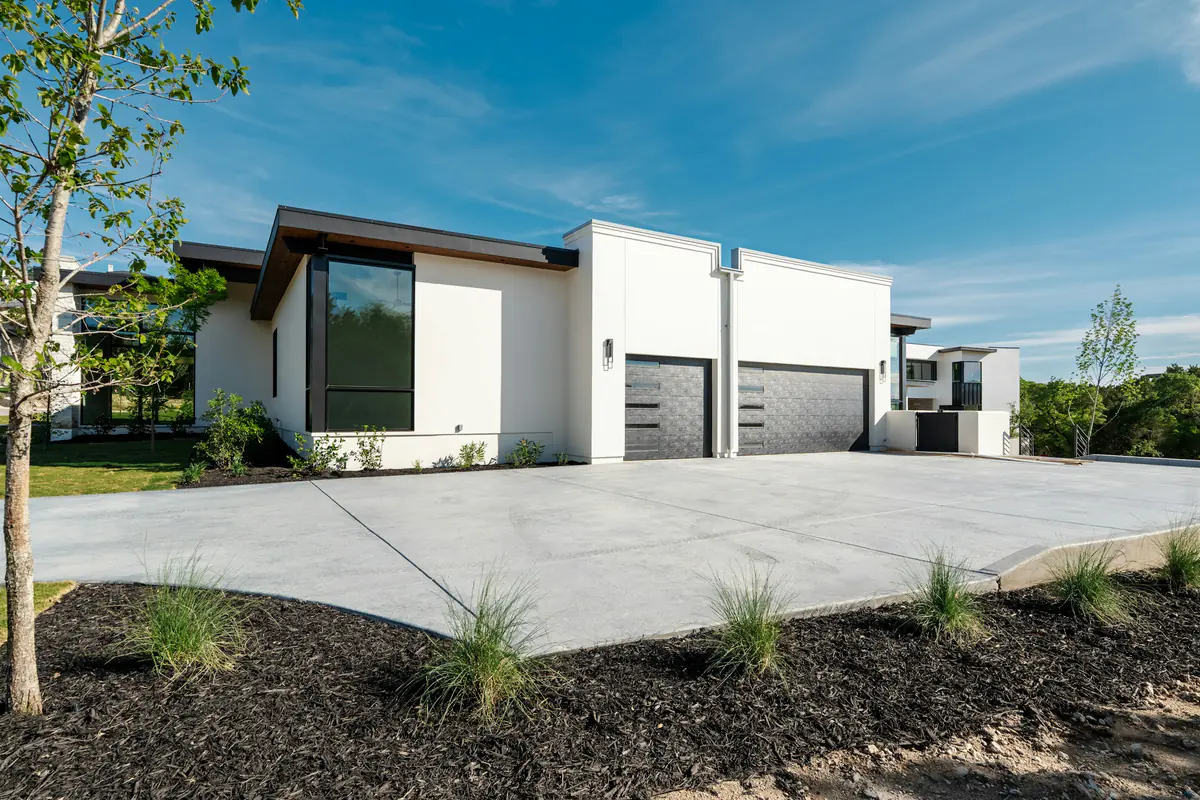
Decorative concrete and pavers give homeowners and businesses real alternatives to asphalt or plain grey concrete. Patterns resembling cobblestone, textures mimicking cut stone: the entrance to the property reads as designed, not as a place to park.
Modern concrete products also mean we can refresh or resurface a plain grey driveway instead of breaking it out, a cost-effective way to change the front of a house when the existing slab is sound. A decorative driveway is a long-term investment, and the result depends entirely on the materials chosen and the quality of the execution, so we quote the preparation as carefully as the finish. Concrete is an environmentally sustainable choice as well.
Commercial entrances, parking areas and municipal walkways run to a different specification, a different pour schedule and a heavier set of load assumptions, so we treat that work on its own terms. See commercial flat work
Living with it
Sealer is the
wearing surface.
Decorative concrete doesn't wear from the concrete down. It wears from the sealer up, and that's the part you can renew without touching the slab.
Most exterior decorative concrete wants resealing every two to three years, sooner on a south-facing drive that takes full sun all day and sooner again where tyres turn on the spot. Resealing is a wash, a dry and a fresh coat; it isn't a rebuild. Left too long, the sealer thins out, the colour flattens and moisture starts reaching the coloured surface itself, which is a harder problem to reverse.
Freeze-thaw cycling is the other force at work. Water enters the surface during the day, freezes overnight, expands and pushes the top layer apart. Air-entrained concrete gives that expanding water somewhere to go, which is why air entrainment is standard practice for exterior flat work in this climate. A sound sealer limits how much water gets in to begin with.
De-icing salts are hard on decorative concrete. Chloride-based products, and ammonium sulphate or ammonium nitrate fertilisers used as ice melt, drive extra freeze-thaw cycling at the surface and attack the paste directly. Sand gives traction without chemistry. Cars coming off salted roads also drip brine onto the slab, so give a driveway a rinse in a winter thaw.

Next step
Ready to get started?
Send us the size of the area, what it connects to and a photograph of what's there now. We'll come back with a free estimate for your project.