
Flat Work · Commercial
Commercial flat work. Slabs that carry load.
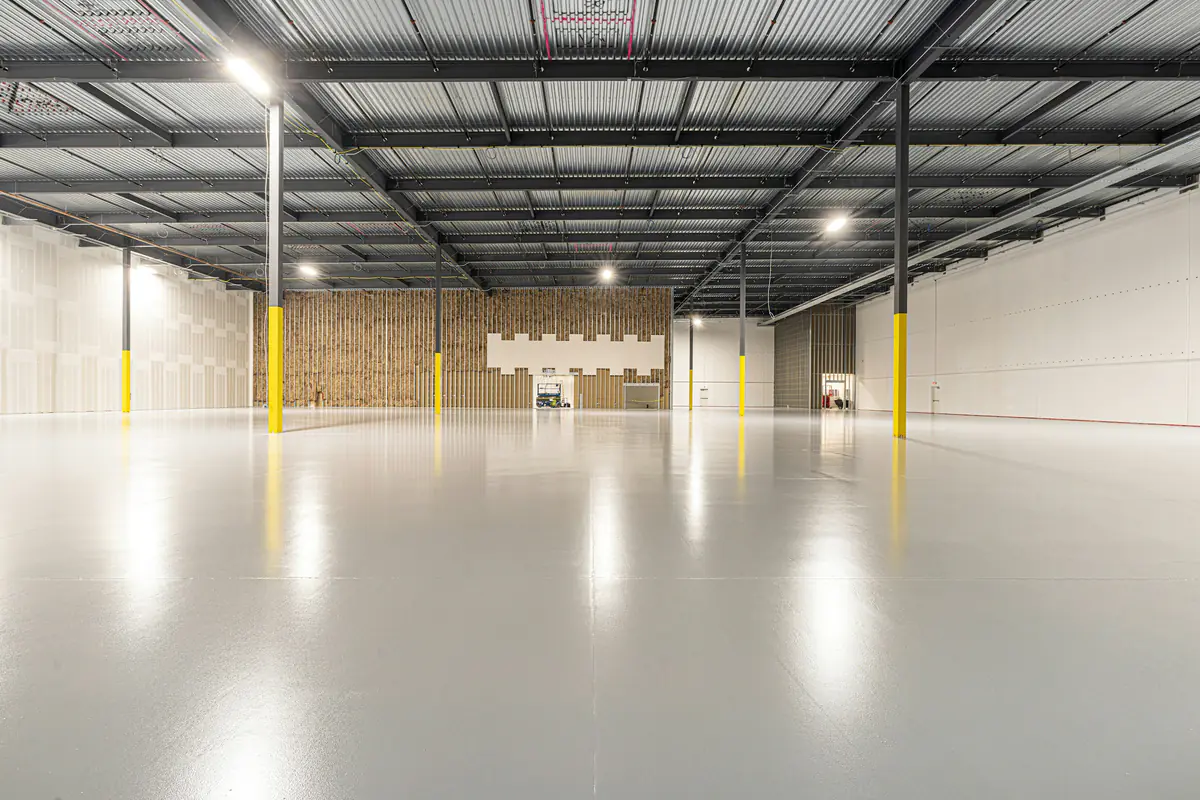
Warehouse floors, loading docks, sidewalks and building foundations, placed with high-strength mixes and proven finishing techniques so the surface holds up under heavy traffic and demanding conditions.
Who we build for
Businesses, municipalities
and developers.
We deliver commercial-grade stamped concrete for businesses, municipalities and property developers, and we work at the scale those jobs ask for. Large decorative pours are their own discipline. A pattern that reads well across a twelve foot patio has to hold its line across a plaza, and the joints that control cracking have to land where the layout wants them as well as where the slab needs them.
Retail plazas, hotel courtyards, restaurant patios and corporate campuses get the same attention to detail as a residential driveway. What changes is scale, sequence and the fact that somebody is usually trying to run a business ten feet from the edge of the pour.
- Retail plazas
- Hotel courtyards
- Restaurant patios
- Corporate campuses
- Entryways and lobbies
- Event spaces
- Municipal walkways
Warehouse floors
A warehouse slab fails at the joints first.
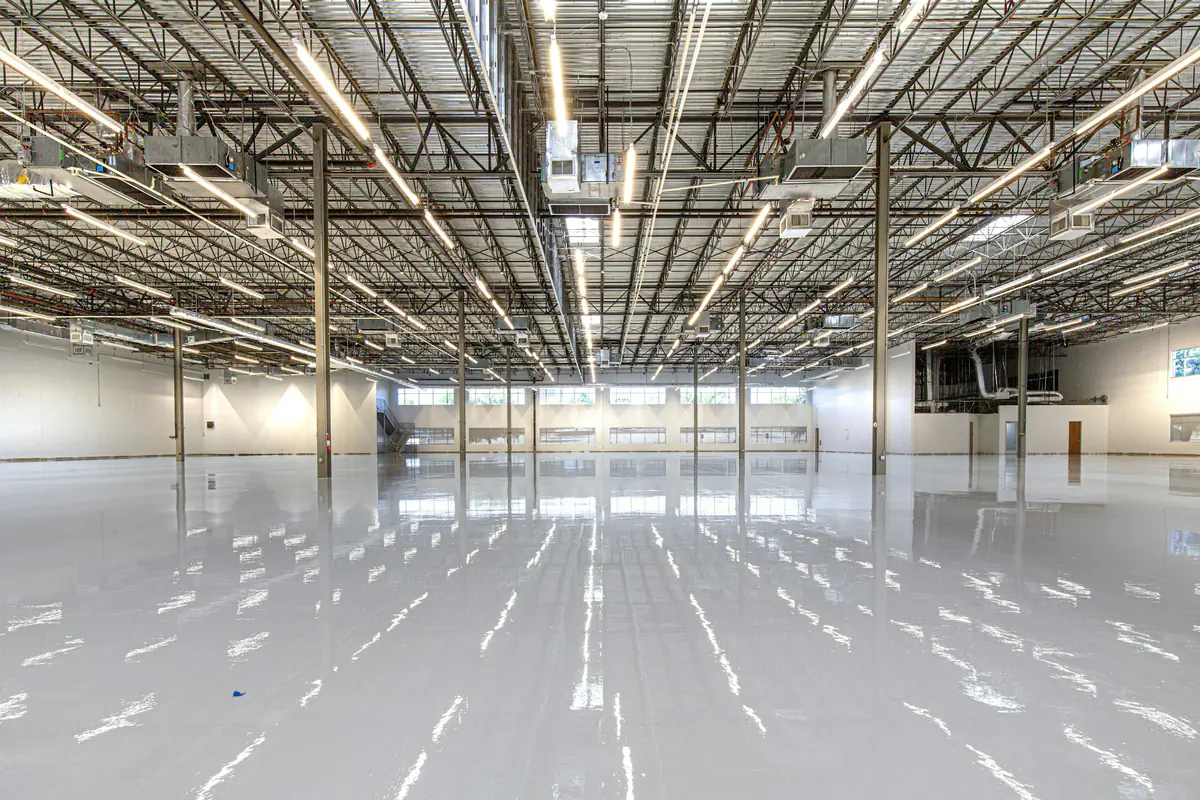
High-load bearing slabs have to take forklifts, heavy equipment and constant foot traffic. The middle of a well placed slab rarely gives trouble. What breaks down is the top inch on either side of a joint, where a hard wheel drops across a small vertical difference several thousand times a week until the arris chips away.
Two things drive that. Concrete dries from the top down. The upper surface shrinks more than the base, so the slab edges lift slightly, and that curling is what puts a lip on either side of the joint. And a joint holds together through load transfer: the ability of one side to share a wheel load with the other. Aggregate interlock alone weakens as drying shrinkage opens the joint, so dowels or plate dowels do the work in slabs that see real traffic.
We lay the joints out before a truck ever backs up to the forms, and we settle the joint filler before the floor goes into service. A semi-rigid filler supports the joint edges against wheel impact instead of leaving them bare.
- Joint layout planned with the racking and traffic pattern, not after it
- Load transfer detailed at construction and contraction joints
- Saw cuts timed to the set: too early ravels the edge, too late and the slab has already chosen its own crack
- Polished or coated finishes available for easier maintenance
Filling joints with a soft sealant on a traffic floor. Soft material moves under the wheel instead of supporting the concrete beside it, and the edge spalls anyway. Traffic joints want a filler hard enough to carry the wheel across.
Tolerances and finish
Flatness is a specification,
not an opinion.
Interior slab tolerance comes back as a number, not an impression. If your drawings carry one, we need it before we plan the pour, because it decides how we place and finish the concrete.
ASTM E1155 reports flatness and levelness as F-numbers. FF describes how much the surface bumps and dips over short distances; FL describes how far the plane drifts from level across the floor. Higher numbers mean tighter tolerance. A general storage bay and a very narrow aisle racking system aren't the same problem, and the second one costs more to build because it demands a different placement method, a different finishing schedule and more hands on the floor at the right moment.
We don't publish achieved F-numbers on a website, because those belong to a specific slab under a specific specification. Send us the spec section and we'll answer against it.
Finish decisions run backwards into the pour as well. A slab destined for mechanical polishing is a different conversation than one destined for a resin coating, because polishing exposes whatever is in the concrete and a coating covers it.
| Consideration | Mechanically polished | Resin coating |
|---|---|---|
| What it is | The slab itself, ground through progressive grits and chemically densified. | A separate resin film built over a mechanically profiled slab. |
| Slab preparation | Wants a sound, flat slab. Patches, colour variation and surface repairs stay visible. | Grinding or shot blasting to open the surface. The coating hides most colour variation. |
| Moisture in the slab | Vapour passes through the floor, so slab moisture is rarely what causes failure. | Vapour drive can lift a film. Moisture testing before application is standard practice. |
| Appearance over time | Aggregate and cream pattern is permanent. Wear shows as loss of sheen. | Uniform colour. Wear concentrates in traffic lanes and at door thresholds. |
The rest of the site plan
Docks, pads, walks
and parking.
Commercial flatwork covers everything from warehouse floors and loading docks to sidewalks and building foundations, at any scale the site calls for.
Sidewalks and paths
ADA-compliant commercial walkways and pathways built to code, with decorative options where the surface needs to match a brand or a property aesthetic. Cross slope and running slope are what an inspector checks, and we set both at forming. Nobody corrects them afterwards.
Loading docks
Durable aprons and dock pads for repeated heavy vehicle impact, with drainage and slope grading handled as part of the work. A dock apron takes braking, turning and trailer landing gear in the same few square feet, which is why we treat thickness, reinforcement and joint placement there differently than the yard around them.
Building pads and equipment pads
Precision-poured foundations and equipment pads meeting commercial specifications. We coordinate with your general contractor to keep projects on schedule, because a pad that's late or out of position stops the trade that follows it.
Parking lots and commercial driveways
Full-depth concrete parking areas designed for commercial vehicle loads, and decorative or plain concrete driveways for office parks, retail centres and industrial facilities. Concrete carries a longer lifespan and a lower lifetime cost than asphalt alternatives, and it stands up to Colorado freeze-thaw cycling, which is the mechanism that pits and flakes exterior surfaces here: water soaks into the surface during the day, freezes overnight, expands and lifts the top layer away. Air entrainment gives that water somewhere to go, which is why it belongs in every exterior mix in this state.
We can often resurface a worn commercial slab instead of breaking it out, which saves significant cost while restoring appearance and function. Whether that applies depends on what the substrate is doing underneath: surface wear is a resurfacing candidate, active movement or a failed base isn't.
How a commercial job runs
Around your operation,
not through it.
Commercial work is mostly a scheduling problem wearing a concrete costume. The pour is one day. The access, the phasing and the cure are the rest of it.
Read the site and the spec
Drawings, tolerance requirements, mix requirements, drainage, existing slab condition and how you actually use the building through a working week.
Phase the work
We break large floors into pours. One part of the building keeps running while we work in another. We agree access lanes, dust control and delivery routes at this point, not on the morning of the pour. Out-of-hours placement: confirm scheduling terms.
Base, forms and reinforcement
Subgrade preparation and compaction, then forms, vapour retarder where the design calls for one, and steel set to the drawing. Nearly every slab problem that shows up later started here.
Place and finish
High-strength mixes and proven finishing techniques, with the finishing schedule matched to the tolerance the floor has to hit. Saw cutting follows as soon as the slab will carry a saw.
Cure, then return to service
Concrete keeps gaining strength for weeks after it stops looking wet, and curing is what decides how hard the wearing surface ends up. We give you the dates: foot traffic, light wheeled traffic, full load, and coating or polishing if that's part of the scope.
Send the submittal list with the invitation to bid and we'll return it filled in. Licence details and insurance certificates: licence numbers and insurance certificates. Commercial pricing structure: pricing and payment terms.

Next step
Send us the drawings.
Square footage, what runs across the floor, and any tolerance or mix requirement in the spec. That's enough for us to come back with a straight answer on scope and sequence.