
Final Phase Concrete · Coatings
Concrete coatings and polishing.
Epoxy, mechanical polishing and rubber systems for garages, gyms, warehouses, showrooms and retail floors. Everything on this page happens on concrete that's already down.
The coatings division
We work on floors
that already exist.
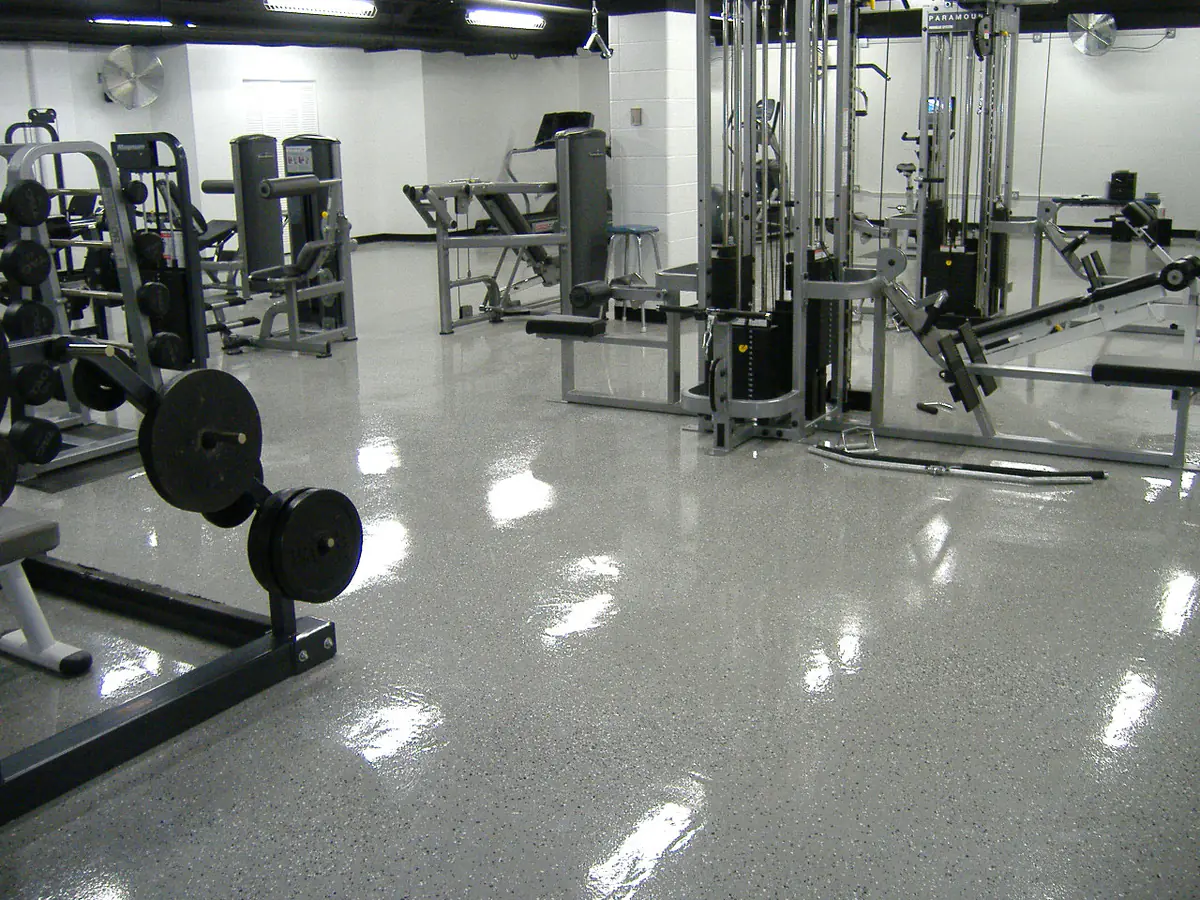
With the help of our epoxy and polyurea coatings manufacturers, we put commercial grade concrete coatings down in working businesses, in a variety of colours. We can bring a gym floor, a sports stadium, a store or a dealership back without anyone tearing out the slab and replacing it.
Coatings live or die on two things: preparation, and what's going on inside the slab. A product datasheet will give you abrasion resistance, chemical resistance and cure times. It won't tell you whether the floor under your feet is clean enough, profiled enough or dry enough to hold anything at all. That part is a site question, and it's the first thing we look at.
Polishing is the exception on this page. It adds nothing at all; it refines the concrete you already own until the slab itself is the finish.
Systems
Four systems.
Four different problems.
These aren't interchangeable finishes at different price points. Each one is good at something specific, and each one has a floor it doesn't belong on.
Commercial Epoxy Coatings
High-build epoxy for floors that take forklift wheels, dropped weights, pallet jacks and constant foot traffic. Built up in coats over a mechanically profiled slab, then topcoated for the gloss level and chemical resistance the room actually needs.
Residential Epoxy Coatings
Garages, basements and workshops. A flake broadcast breaks up the surface so dust, tyre marks and small slab imperfections stop reading, and the finished floor sweeps and mops instead of drinking up whatever leaks out of a vehicle.
Concrete Polishing
No added layer. We grind through progressively finer diamond grits until the slab carries its own finish: sustainable, durable, easy to maintain, and refined to a mirror-like gloss in commercial and residential spaces.
Rubber Floor Coatings
A high-tech polymer resin combined with rubber, applied over nearly any solid interior or exterior surface in commercial and residential settings. Non-slip and soft underfoot, which is what makes it suit any wet deck application.
Epoxy
A polymer system
made since 1939.
We install Rock-Tred Polymer Coating Solutions, an industrial-strength polymer flooring solution created in 1939 that has withstood the test of time. The products cure fast, with a return to service of just 24 hours, and we can apply them in temperatures down to zero degrees.
That temperature figure matters more in Colorado than it sounds on paper. An unheated garage in January sits far below the minimum application temperature printed on most consumer floor kits, which is why so many people attempt them in July and watch them fail by spring anyway.
A residential garage floor goes in start to finish in one day, with a 24-hour stay-off period before you use it. Warranty terms: warranty terms.
- Return to service in 24 hours
- Applied in temperatures down to zero degrees
- Residential garage completed in a single day
- Broadcast flake or solid colour
Preparation
Adhesion is decided
before the first coat.
Nearly every coating failure you'll ever look at is a bond failure, and the hours before anyone opens a pail are where that failure starts.
Concrete cures with a weak, dusty layer of fines sitting at the very top, called laitance. Roll resin straight onto it and the resin bonds beautifully to the laitance; the laitance then lets go of the slab underneath, and the whole system peels off in sheets that carry a grey film on the back.
Mechanical profiling is what prevents that. Diamond grinding or shot blasting cuts the top off the surface, opens the pores, strips old sealer and cure-and-seal residue, and leaves a texture the resin can key into. But acid etching isn't the same job. It leaves salts behind, it dulls a hard-troweled slab instead of opening it, and it won't touch a sealer at all.
Moisture moving up through the slab
The second failure mode is invisible from standing height. A slab on grade sits on damp ground, and unless an intact vapour retarder went in underneath it, water vapour travels up through the concrete and out into the room. A film-forming coating stops that traffic dead. Pressure builds under the film and lifts it into blisters, sometimes months after the floor looked perfect.
So we measure the slab before anything goes down. Calcium chloride tests and in-situ relative humidity probes both quantify how much moisture the slab is giving off. A floor that reads high needs a moisture-tolerant primer, or a different system altogether.
Coating over an existing sealer. Old cure-and-seal, garage paint and acrylic sealers all read as bare concrete once they're dirty enough. Drop water on the floor: if it beads instead of darkening the surface, something is already on that slab and it has to come off mechanically first.
Polishing
A coating adds a layer.
Polishing refines the slab.
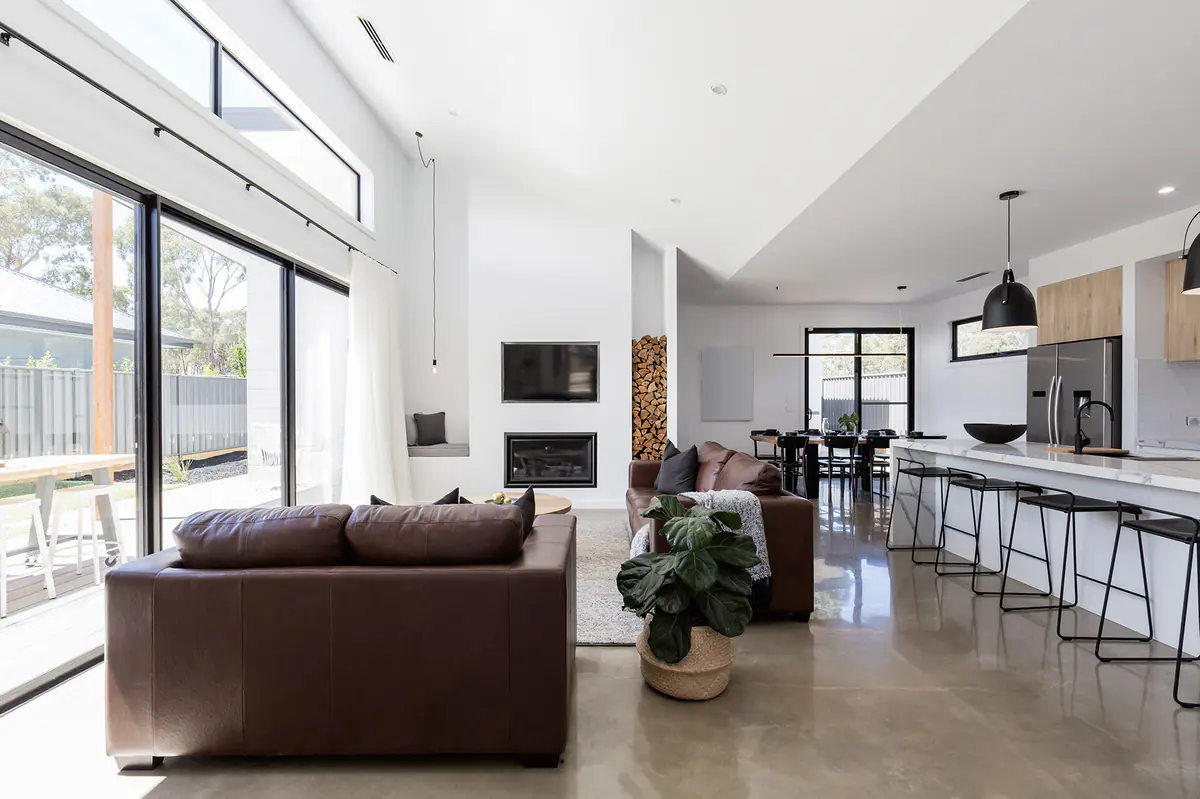
There's no film involved. We grind the concrete through progressively finer diamond grits, densify the surface chemically so it hardens, and keep refining until it reflects. Polished concrete floors are impressive in appearance and function: a sustainable, durable and easy-to-maintain floor with a mirror-like finish.
Because the finish is the concrete, there's nothing to peel and nothing to blister. Moisture vapour passes out through a polished floor instead of collecting under it, which removes the single biggest risk a resin system carries on a slab of unknown history.
What you trade away is control. Colour comes from the slab, from how deep we cut and from how much aggregate that exposes. There are still a variety of ways to modify a polished floor for a completely customised look in commercial and residential spaces.
- No added film to peel, blister or delaminate
- Cut depth sets how much aggregate shows
- Dyes and final grit change colour and sheen
- Maintained by dust mopping and a neutral cleaner
Appearance
Flake, solid colour,
and what goes on top.
Two decisions change how a resin floor looks and behaves more than any other: what goes into the body coat, and what goes over it.
Broadcast flake or solid colour
We throw flake into the wet base coat until the surface won't take any more. Then we scrape it back flat and lock it under the topcoat. That fine texture adds slip resistance, and it breaks the floor up visually so dust, tyre marks and minor slab repairs stop announcing themselves. Solid colour does the opposite of all of that. It reads calm and architectural, and it shows everything: every roller lap, every patch, every ripple the slab already had.
Topcoat chemistry and sunlight
The topcoat sets gloss, chemical resistance and how the floor ages. Standard aromatic epoxies and urethanes amber under ultraviolet light, and ultraviolet exposure at Colorado altitude is stronger than it is at sea level. Any floor that sees direct sun through a door or a glazed wall wants an aliphatic topcoat, which holds its colour far longer.
Gloss is a separate decision from chemistry. A high gloss throws light around a dark garage and makes the floor look wet and deep, but it also picks out every fleck of dust and every tyre mark within an hour of cleaning. A satin or matte topcoat gives up some of that depth and hides day-to-day traffic far better. In a showroom the gloss is usually worth the upkeep; in a working shop it rarely is.
Choosing
Start with the room,
not the finish.
A gym takes impact. Warehouses take abrasion and point loads, garages take road salt and hot tyres, and a pool deck takes standing water on bare feet. Four different problems, four different answers.
| Criterion | Epoxy coating | Polished concrete | Rubber coating |
|---|---|---|---|
| What it does to the slab | Bonds a resin layer over the surface | Refines the existing slab, adds nothing | Bonds a resin and rubber layer over the surface |
| Surface underfoot | Hard; smooth, or textured where flake is broadcast | Hard, smooth, high gloss | Soft and non-slip |
| Where it suits | Gyms, stadiums, stores, dealerships, garages | Commercial and residential interiors | Wet decks, interior or exterior |
| Where colour comes from | Base coat colour plus the flake blend | The concrete and its aggregate, modified by dyes | The rubber granule blend |
| Slab moisture | Film traps rising vapour; test the slab first | Vapour passes through; no film to lift | Film traps rising vapour; test the slab first |
| Direct sunlight | Needs an aliphatic topcoat or it ambers | Normally an interior floor | Rated for exterior use |
Ask how they'll profile the slab, and with what machine. Ask what the moisture meter read. Ask which topcoat is going on, whether it's aliphatic, and how it holds colour in direct sun. An installer who answers those three without hedging has thought about your floor, not their price.
Products and systems we install


Next step
Send us a photo of the floor.
Square footage, what the room is used for, and whether anything has been put on that slab before. That's usually enough for a straight answer about which system fits.